
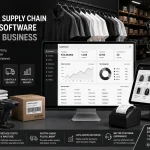
The garment industry operates in a highly competitive environment where inventory accuracy, timely deliveries, supplier coordination, and customer satisfaction directly impact profitability. Managing these operations manually often leads to stock shortages, overstocking, delayed orders, and operational inefficiencies. Retail Supply Chain Management Software helps garment businesses streamline their entire supply chain, from procurement to sales, ensuring faster operations and better decision-making.
Solutions like the Retail POS System, Inventory Management System, and Warehouse Management Software offered by Salvocore Innovations enable garment retailers to automate processes, improve visibility, and boost overall business performance.
Why Supply Chain Management Matters in the Garment Industry
Garment retailers handle thousands of SKUs, multiple sizes, colors, seasonal collections, suppliers, and customer demands. Without an integrated system, businesses struggle to maintain inventory accuracy and efficient operations.
A modern supply chain management solution centralizes inventory, sales, procurement, and warehouse operations, helping retailers reduce costs while improving service quality.
1. Real-Time Inventory Visibility
One of the biggest challenges in garment retail is maintaining accurate stock levels across stores and warehouses.
Retail Supply Chain Management Software provides:
- Real-time inventory tracking
- Automated stock updates
- Low-stock alerts
- Fast-moving product identification
- Better inventory forecasting
This reduces stockouts and prevents excess inventory from tying up capital. Salvocore’s Inventory Management and POS solutions help businesses monitor stock movement efficiently across all locations.
2. Faster Order Processing
Customers expect quick fulfillment, whether shopping online or in-store.
Supply chain software automates:
- Order creation
- Inventory allocation
- Billing and invoicing
- Shipment coordination
- Order tracking
Automated workflows eliminate manual errors and significantly reduce processing time, allowing garment retailers to serve customers faster.
3. Improved Warehouse Management
Garment businesses often store products in multiple warehouses and distribution centers.
Warehouse Management Systems help by:
- Tracking product locations
- Managing inbound and outbound inventory
- Optimizing picking and packing processes
- Reducing warehouse errors
- Improving inventory accuracy
Salvocore’s Warehouse Management System enables organizations to control warehouse operations from the moment goods arrive until they are dispatched.
4. Better Demand Forecasting
Fashion trends and seasonal demand can change rapidly.
Advanced supply chain software analyzes historical sales data to:
- Predict demand patterns
- Identify popular products
- Plan seasonal inventory
- Reduce dead stock
Accurate forecasting helps garment retailers maintain optimal inventory levels and maximize profits. Research also highlights the importance of computerized decision-support systems for forecasting and inventory planning.
5. Enhanced Supplier Management
Managing multiple fabric suppliers, manufacturers, and distributors can be complex.
Supply chain management software improves supplier coordination by:
- Tracking purchase orders
- Monitoring supplier performance
- Managing procurement workflows
- Ensuring timely replenishment
This leads to stronger supplier relationships and fewer supply disruptions.
6. Seamless Multi-Store Operations
Many garment brands operate across multiple locations.
An integrated system allows businesses to:
- Monitor stock across branches
- Transfer inventory between stores
- Standardize pricing
- Consolidate reporting
- Track store performance
Centralized management improves operational control and supports business expansion.
7. Reduced Operational Costs
Manual processes increase labor costs and create opportunities for costly errors.
Retail Supply Chain Management Software helps reduce expenses through:
- Process automation
- Accurate inventory management
- Lower stock wastage
- Reduced manual data entry
- Better resource utilization
This improves overall profitability while allowing staff to focus on higher-value tasks.
8. Better Customer Experience
Customers are more likely to return when products are available and orders are delivered on time.
Benefits include:
- Faster checkout processes
- Accurate stock availability
- Timely deliveries
- Improved order tracking
- Consistent customer service
A connected POS and inventory system ensures customers receive a smooth shopping experience across all channels.
9. Data-Driven Decision Making
Modern supply chain software provides powerful reporting and analytics tools.
Garment retailers can analyze:
- Sales performance
- Inventory turnover
- Supplier efficiency
- Customer purchasing trends
- Profitability metrics
These insights enable business owners to make informed strategic decisions and improve growth outcomes.
Why Choose Salvocore for Garment Retail Management?
Salvocore Innovations offers customized software solutions including:
- Retail POS Systems
- Inventory Management Software
- Warehouse Management Systems
- ERP & Business Automation Solutions
- AI-Powered Business Applications
These solutions are designed to help retailers automate operations, improve inventory control, and enhance overall supply chain efficiency.
Conclusion
Retail Supply Chain Management Software is no longer a luxury for garment businesses—it is a necessity. By automating inventory management, warehouse operations, procurement, and order fulfillment, garment retailers can reduce costs, improve efficiency, and deliver better customer experiences.
With advanced solutions from Salvocore Innovations, garment businesses can build a smarter, more agile supply chain that supports sustainable growth and long-term success.